water tube boiler
Membrane wall boiler based on the natural circulation principle
Our water tube boilers in membrane wall design combine a compact, modular construction with safe operation. Depending on the requirements of industrial processes, we build the water tube boiler as a single-drum boiler for open steam-condensate systems or in vertical natural circulation boiler design for closed processes. Thanks to individual thermodynamic design and flexible fuel options, they are ideal for applications with high pressure and capacity requirements where efficiency and operational reliability are critical.
Product variants at a glance
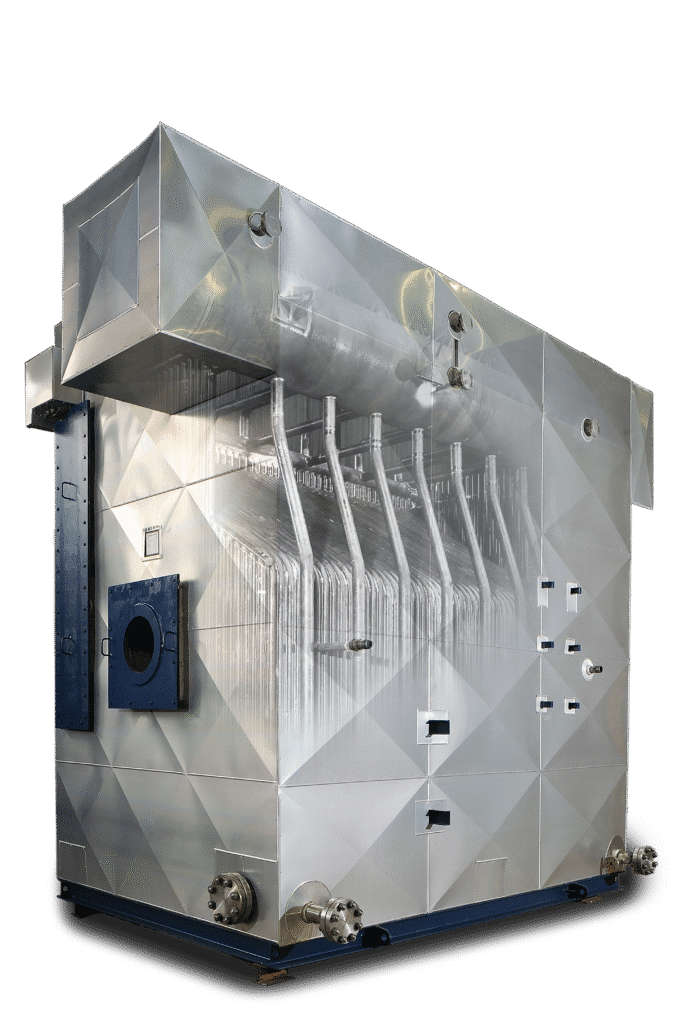
Water tube boiler WRK
Natural circulation boiler
Steam and hot water generators
- Steam capacity up to 100 t/h and 100 bar (g)
- Heating capacity up to 60 MW
learn more
The SCHNEIDER WRK is a natural circulation boiler of the water-tube type and is manufactured as both a steam and hot water generator. In both boiler types, the tube bundle is constructed in the same way, namely from prefabricated tube elements containing the combustion chamber and contact heating surfaces. This design distinguishes it fundamentally from the conventional natural circulation water-tube boiler, which has been manufactured for over 100 years as a multi-drum boiler with heated downcomers.
Areas of application
- food industry
- Chemical industry
- Oleochemical industry
- Pharmaceutical industry
- Oil and gas industry
- energy supply
- Local and district heating supply
Benefits
- Use of various fuels
- Extremely high load change rates with stable water level
- Compact design and self-supporting boiler construction
- Production of completely dry steam
- Ideal adaptability to the spatial conditions of the installation site
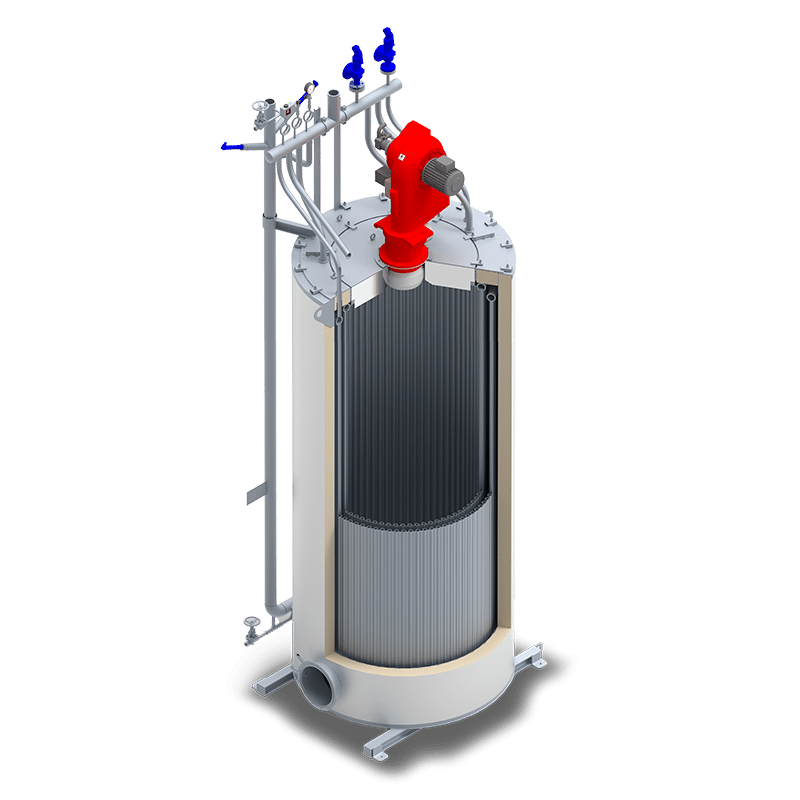
High-pressure steam boiler iNook
Trommelloser Kessel in Membranbauweise
Steam generators for closed circuits
- Heating capacity up to 6.0 MW and 100 bar
learn more
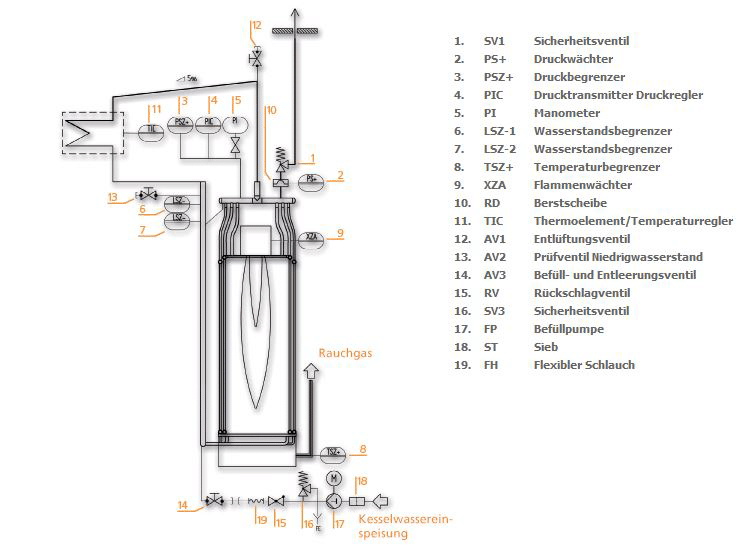
The iNook is a drumless vertical boiler with a membrane wall design that has been specially developed for closed steam circuits. It is operated in a closed natural circulation system and is connected directly to the heat consumer without a shut-off valve. The steam produced serves solely as a heat transfer medium, which transfers the energy contained in the steam to a secondary process for heating via a heat exchanger (condenser).
Benefits
- Membrane wall construction
- 100% smoke gas tightness between the flues – no leakage
- Highest possible efficiency compared to other designs
- Direct integration of the evaporator pipes into the manifolds (without reducers)
- No risk of heating surface overheating / flow interruptions
- Number and arrangement of steam discharge pipes
- Minimization of pressure losses in the boiler system
- Increase in water circulation rates
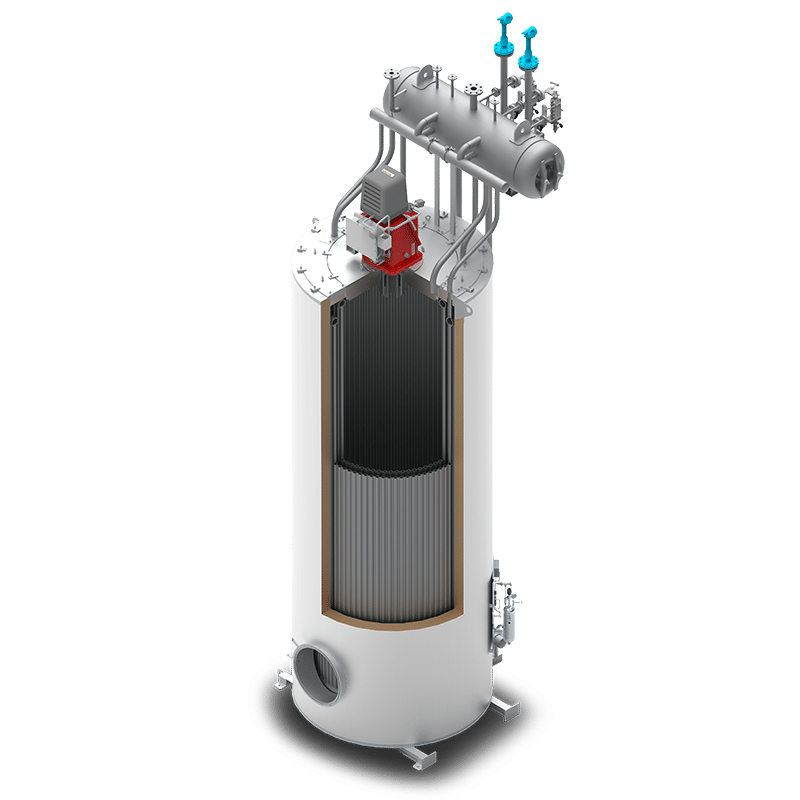
High-pressure steam boiler HPB
With steam drum
Steam and hot water generators
- Steam capacity up to 20 t/h (15 MW) and 150 bar (g)
learn more
The HPB vertical high-pressure boiler is a high-pressure steam boiler with a steam drum, specifically designed for open steam circuits and confined spaces. The boiler supplies high-pressure steam for process plants subject to strict safety regulations – particularly in production areas where leaks occurring in (customer-supplied) heat exchangers must not contaminate the product, or where steam is used directly as a reactant in the final product.
The HPB is a natural circulation boiler in which the steam drum is positioned above the vertical evaporator tube bundle.
The boiler pressure section – comprising the steam drum and tube bundle – is usually supplied as a complete unit together with the riser, overflow and downcomer pipes, as well as the boiler fittings; this enables quick and easy on-site installation.
If space is limited, the drum can be supplied separately and installed on site. Depending on the available space, this can be done at any point above the boiler.
The key advantage of the HPB lies in the design of the pipe cage as a completely flue-gas-tight pipe wall construction. The connecting pipes can be customised as required.
Areas of application
- The oil, fats, food and beverage industries
- Oleochemistry, fat hydrolysis
- Deodorisation of edible oils and fats
- Distillation, fractionation, esterification
Benefits
- Use of various fuels
- Extremely high load change rates with stable water level
- Compact design and self-supporting boiler construction
- Production of completely dry steam
- Ideal adaptability to the spatial conditions of the installation site
How the WRK works
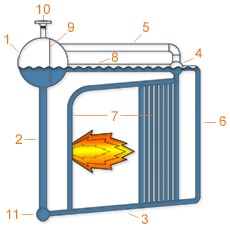
- Steam drum – unheated
- Downpipe – unheated
- Floor pipes – heated
- Upper collector – unheated
- Overflow pipe – unheated
- Return pipe – unheated
- Riser pipe – heated
- Mixing pipe – unheated
- Partition
- Steam extraction
- Lower collector – unheated
Design
Special water circulation system
The water circulation system of the SCHNEIDER-WRK has several special features that differ significantly from those of other natural circulation boilers, in particular double-drum boilers. In the SCHNEIDER-WRK, only the riser pipes (7) and the bottom pipes (3) are heated, while the steam drum (1), the downpipes (2), the overflow pipes (5), the return pipes (6), the mixture pipes (8) and all collectors are unheated. The steam-water mixture produced in the riser pipes (7) and bottom pipes (3) rises into the unheated upper collector (4). Here, almost complete steam-water separation takes place (gravity principle). The separated steam flows through the overflow pipes (5) into the steam drum, specifically into the area behind the partition wall above the lowest water level. Approximately 50% of the separated water flows through the unheated return pipes (6) towards the bottom pipes (3), while the remaining water flows through the mixture pipes (8) into the steam drum behind the partition wall below the lowest water level NW. From here, the circulating water then falls through the unheated downpipes (2) into the lower collector (11), from where it is then distributed back into the heated boiler sections (3) and (7) – and the cycle begins again.
Functional principle of the iNook
Benefits for your application
- Efficient and safe steam generation via a natural circulation system
- Maximum adaptability
- Compact designs for confined installation spaces
- Industrial-grade steam – dry, stable, and reliable
- Suitable for various fuels – flexible and future-proof (oil, gas, hybrid with electric heating)
Customized planning & engineering
We offer project-based engineering and design for all thermal engineering equipment:
- Heat balance calculations
- Design and manufacture according to customer specifications
- Comparison of variants
- Cost-benefit analyses
Norms and Certifications
Manufactured in accordance with the EU Pressure Equipment Directive 2014/68/EU and standard EN 12953.
ASME standards or marine applications are also available on request.
Talk to our experts
Whether you need a new system or want to optimize existing steam systems, we provide individual advice and find the right solution for your process.